

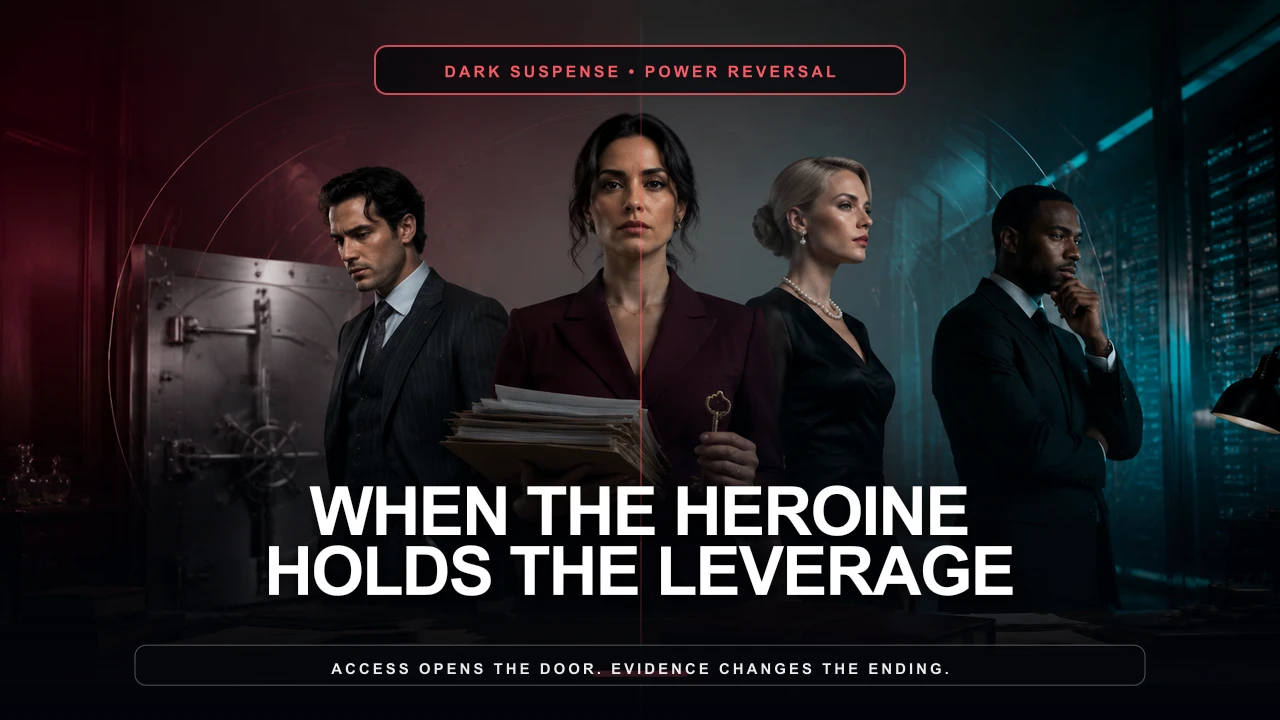
When the Heroine Holds the Leverage: Seven Stories That Make Power Cost Something
Power in dark suspense is easy to display and harder to dramatize. A locked estate, armed guards, a famous surname, or a university donor can make a character look untouchable. The real story begins when that power meets a limit. Someone keeps a copy. A witness controls consent. A bride reads the contract. A target learns how the institution manufactures guilt.
The seven stories in The Danger Files share one design rule: an ally may have access, but the heroine has leverage. Access opens a server room, family council, neonatal record, safehouse, or sealed court file. Leverage decides what happens after the door opens.
A Stolen Name Must Become Public Again
In The Daughter in the Locked Wing, Mira Hawthorne's family has confined her under her dead sister's name while cousin Celia appears at galas, uses Mira's passport, and prepares to inherit the family trust. An estate attorney can open legal doors, but his signature also helped turn the false psychiatric record into a court order.
Mira's leverage develops from several records that fail differently: a passport fragment proves a prior identity, camera gaps prove a concealed event, a licensing audit proves the diagnosis was backdated, and household witnesses explain motive. None is a miracle key. Together they make it impossible for the family to keep treating her existence as a symptom.
The public payoff arrives when both women step onto the succession stage. Mira does not win by looking more authentic than Celia. She wins by controlling the sequence in which Lydia Hawthorne denies documents, witnesses, rehearsal videos, and finally her own repeated language.
Two Mothers Can Refuse the Custody Spectacle
The Baby with Two Birth Certificates begins with a newborn discharge packet containing two valid identities. Lena Park understands medical records well enough to know that a second protected-paper serial is not a typo. The harder problem is that another mother has already left the hospital with an infant and fully lawful-looking placement documents.
This story gives leverage to a coalition rather than one rescuer. Ivy has the recorded refusal from labor. Naomi has the agency invoices. A nurse kept off-chart shift notes. A registrar can prove how certificate stock was used. A pediatrician must admit that his old emergency-transfer design created the pathway later exploited by hospital counsel.
Ivy and Naomi refuse the public image of two women fighting over one baby. They consent to private testing, preserve both children's care, and define which facts may become evidence. Their restraint makes the accreditation hearing more powerful: the institution loses the ability to hide behind privacy without forcing either family to surrender it.
A Deepfake Case Is Also a Source-Control Case
In The Video That Stole Her Face, safety engineer Aria Chen sees herself accepting a bribe on every screen at a creator convention. One sentence in the recording is real. That authentic fragment turns a simple denial into a trap and points toward unreleased source footage held by only a few people.
Aria's leverage is not an expert announcing that pixels look wrong. She connects protected source watermarks, paid distribution timing, procurement invoices, a camera card, and the executive authorization used for the final release. A prior target contributes nonvisual receipts while keeping intimate source material sealed. The investigation can prove coordination without demanding that a victim expose herself again.
The final hearing shifts attention from whether an audience believes Aria to who controlled the source, money, and release command. Her public answer is deliberately narrower than the lie. That narrowness is what makes it verifiable.
Kidnapping Creates a Test of Autonomy
In The Hostage He Stole Back, Nico Calder can move through the criminal network that kidnapped Lena Voss. He knows safehouses, guards, routes, and family codes. That makes him useful. It does not give him the right to decide where Lena goes after the warehouse raid.
Lena's leverage is the laundering ledger she reconstructed from memory. More importantly, she understands what the numbers mean. The Calder family can steal a drive, kill a bookkeeper, or threaten a prosecutor, but it cannot replace her judgment without exposing the accounts to people who know how to read them.
Their alliance deepens when Nico accepts boundaries that reduce his own control. He puts the key on Lena's side. He names the cost of each offer. He eventually rejects succession and gives evidence against his father. Those actions do not erase his criminal past; they prove he is willing to lose the power that made coercion possible.
This structure keeps the kidnapping from becoming a shortcut to intimacy. Physical confinement begins the danger. Verifiable choice begins the relationship.
A Mafia Bride Can Read the Fine Print
Lucia Moretti enters Bride of the Enemy Don as a peace term negotiated by men who expect her obedience. Her leverage comes from understanding the performance around the deal. She knows why a chair was moved, which cousin repeats her father's signals, and where her mother would hide evidence in a ceremonial dress.
Matteo Serrano has the estate, guards, accounts, and title. Lucia has the ability to make both families reveal what they think a bride will not notice. When Matteo follows her strategy at a council dinner, he loses support among captains who interpret collaboration as weakness. The cost makes the choice credible.
The ending does not preserve the original treaty with better feelings. Lucia and Matteo dismantle the councils that treated them as inheritable property. Any future marriage requires exit rights, separate property, and a decision made after the emergency. Their relationship follows structural change.
Bullying Depends on Control of the Record
The Bellweather Circle in The Scholarship Girl They Tried to Break rarely needs physical violence. It controls housing files, internship recommendations, conduct hearings, donor access, and the vocabulary used to describe a target. Once enough official documents repeat the same accusation, cruelty begins to look like consensus.
Mara Reyes fights on that terrain. She requests metadata during a hearing designed to shame her. She files preservation notices before servers can be wiped. She discovers that one scholarship student has been selected each year and that the same administrative sequence follows every selection.
Adrian Bell's master key provides access, but Mara controls how the archive is used. She refuses to publish survivor records without consent. Adrian must write a sworn account of the system he helped build and accept that remorse does not entitle him to a relationship. The story gives the target more than a victorious speech. It gives her authority over the remedy.
A Stolen Name Can Become a Public Case
In The Gang That Buried Her Name, officials offer Talia Quinn a corrected death certificate if she withdraws Lucian Rook's testimony. The private offer is tempting because her sister Eva deserves her real name. It is also designed to preserve every official who helped steal it.
Talia's leverage is procedural. She can place names into open court, freeze accounts tied to Eva's identity, and turn a gang murder into a fraud case touching city contracts. Lucian knows the family network and accepts legal consequence for his own role. His usefulness does not require Talia to pretend he is clean.
Their relationship grows around a shared refusal: neither will buy a personal future by abandoning the witnesses still trapped in the system. Restoring Eva's name matters because the public record changes with it.
The Cost Is the Proof
Dangerous or compromised allies often arrive with impressive resources. The more important question is what they surrender when the heroine uses her leverage. Elias admits the signature that enabled confinement. Daniel exposes the emergency pathway tied to his name. Jonah gives up editorial control. Nico gives up succession. Matteo dissolves his council. Adrian names himself in the evidence. Lucian testifies and accepts sentence.
The heroines pay costs too, but they do not pay by losing the right to define what happened. Mira decides how her identity returns to public record. Lena protects both infants while building the case. Aria refuses to trade victims' privacy for a stronger broadcast. The other Lena decides when the crime ledger moves. Lucia chooses whether the marriage continues. Mara controls the survivor archive. Talia refuses a private correction in favor of public truth.
That is the promise of The Danger Files: high-risk plots, morally compromised institutions, and romantic choices that become meaningful only after power has a price.
Start reading now — free, no account required.
Read The Daughter in the Locked Wing →