Chapter 23
Something That Has to Be Built
The court had changed in a way that couldn't be walked back.
Three days after the breaking, the crimson light was gone from the mortar lines. What remained was the stone beneath it — darker, older, the actual color of the building before five centuries of blood magic had put its undertone into everything. She had walked the east corridor twice this morning and each time the absence struck her again: not as loss, as correction. The court as it had been before it learned to run on taking.
She'd been thinking about Thornvale.
Not the village itself — the logic of it. The settlements along the eastern tithe boundary organized their whole calendar around the interval. Which houses sat at the edge of the safe perimeter. Which families planted close, knowing close was temporary. Children in eastern Thornvale learned to count in multiples of thirty-three because thirty-three was the shape of time, the number that enclosed everything. You didn't build past it. You built toward the arrival of it, the way you built toward weather: preparation, endurance, the expectation that something outside your making would determine the shape of your days.
The court had been built the same way. Five centuries of being fed from outside it, everything organized around that feeding — the blood magic infrastructure, the political structure, the particular way people moved through its halls. All of it oriented toward the interval, toward what couldn't be stopped. Toward what the cycle required.
What she had been turning over for three days was: but it doesn't have to be.
She found him at the south overlook.
A narrow gallery looking down into the interior garden, which was untended and not yet growing anything. He was at the far end. He turned before she was close enough to have made sound — a habit of his she had catalogued early and decided not to question.
The light through the south windows was different without the crimson undertone. Neutral. He looked the same as he always looked. She noticed it, and then noticed that she'd expected something different.
"I've been thinking about Thornvale," she said.
He waited.
"About how villages built near the tithe boundary organized themselves." She came to stand at the gallery's end, close enough that this was a conversation, not a report. "They didn't build toward anything. They built against loss. Everything oriented toward the cycle — toward what was going to be taken, toward the interval, toward what couldn't be changed." She looked down at the empty garden. The old drainage channels, the bare beds, the paths that led nowhere in particular. "The court was built the same way. Five hundred years of being fed from outside it, and everything in the court — everything it was — shaped around that feeding." She let that settle. "It can be rebuilt now. From the inside. Not through sacrifice and not through what it took from elsewhere, but through what the people in it actually are, without five centuries of accumulated weight on top of it."
He was quiet for long enough that she turned to look at him. He was watching her with the quality she associated with things rearranging themselves in his understanding — not surprise, something more careful. The expression of a man for whom the category possible had just been extended by a measurement he hadn't taken before.
"Something that has to be built from the inside," he said. "Not fed from outside it."
"Yes." She turned back to the garden. "I know something about what that requires. I come from a place that had to choose it."
The quiet that followed was the particular quiet of a thing that had been said and was being received, not filled. She had learned his silences well enough to know this one: active, not absent.
After a while she became aware of his attention shifting. Not away from the thought she'd offered — the thought was still in the room, she could feel it — but toward her. The way he sometimes looked at things he was recalibrating his understanding of.
"What are you now," he said.
She held it for a moment. This was the direct form — her, who she was, now that the thing was done. Not bloodline, not function, not political category. Her.
She gave it the honest answer.
"Still Saya Aldren from eastern Thornvale," she said. "Who stood at a border three minutes before the garrison rotation and made a choice she didn't think all the way through, and has been living inside that choice ever since." She watched the empty garden below, the altered light. "Also the person who broke a five-hundred-year cycle. Both of those are true at the same time. I've stopped trying to make them into one thing."
She heard him take a breath. The particular quality of a breath that comes before a decision that has been made and is about to be spoken.
"I'm asking you to stay," he said.
No strategic framing, no political necessity attached to it. He said it plainly — which was not his default register for things he wanted — and she understood what it cost him to arrive at this form: someone who had spent five centuries moving toward things without naming them, speaking the named version, without the distance he usually kept between himself and what he wanted.
The asking mattered. She let it.
"Yes," she said.
She said it because she wanted to know who he was when he had to build something instead of feed it. She had watched him manage a court sustained by taking for eleven months — the decisions, the precise way he moved through problems, the face she'd spent a long time learning. She wanted the other version: the one that had to make something new from what was actually present. She wanted to be in this court for that, which was not the same as staying for the court's sake, and was not only about him, and was also both of those things.
She didn't simplify it. Neither did he.
She found Kira near the inner passage in the afternoon, standing in the doorway of the room that had been her quarters for six years. Kira was holding nothing. She had the expression of someone who had arrived at an open question and was not yet at the part where she could close it — not her usual self-containment, not the careful economy of what she chose to show. This was an expression without a decision in it.
The old court's structure was gone. Whatever terms had governed Kira's being here for six years had been tied to that structure, and Saya did not know the full weight of what was now uncertain for her.
"I don't know what changes for you," Saya said.
"No." Kira's voice was level. "Neither do I."
Saya held that. She offered nothing false. "The old terms aren't the only terms available now."
Kira looked at her for a few seconds with the expression she used for information she intended to keep. Then she nodded — small, precise — and turned back into the room.
Saya moved on.
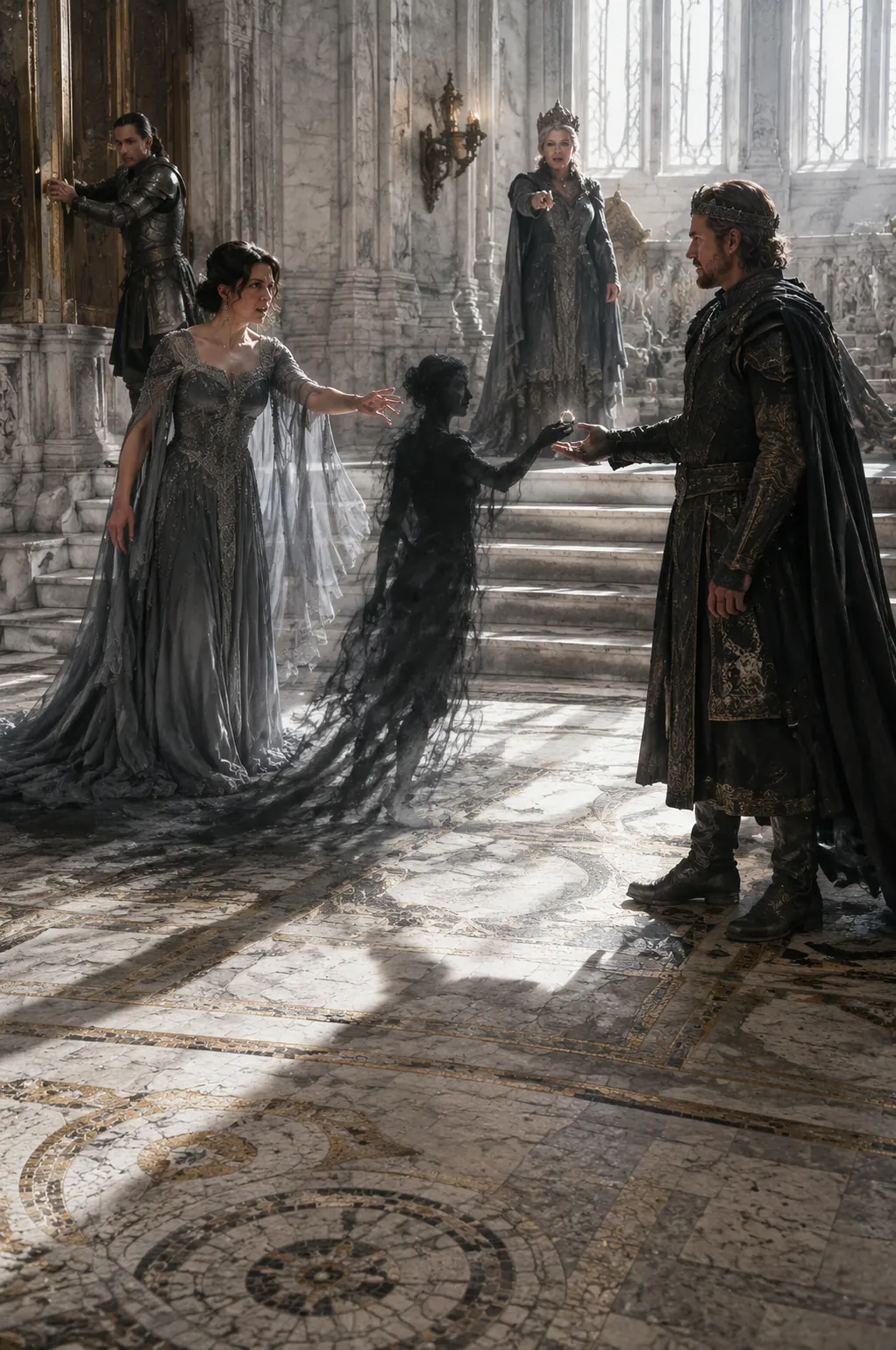
At the end of the day she stood with him in the main hall.
The space was the same dimensions it had always been. Forty feet of dark stone, the high windows, the proportions she had learned the way you learned a room you spent a long time inside — unconsciously, until you knew it the way you knew your own breathing. But the crimson was gone. The stone that remained was what the court was made of before the blood magic put its color into everything: gray, deep, old, the actual material of the place.
She was standing close enough to feel the warmth of another person. He was looking at the same thing she was — the hall, the changed light, the length of a space they had been in together a hundred times and were in again now for the first time under these conditions.
"It won't be fast," he said.
"No," she said.
The court held them there. In the corridors beyond she could hear the sound of the building in its new state — boot-steps, a door, a structure that was still itself and was no longer what it had been. Somewhere in the interval between what it was and what it would become. The only place from which something could be built.
Somewhere above, boots crossed an upper corridor. A door closed. The building was still occupied, still running.
She put her hand against the nearest pillar. Dark stone, cold, no warmth in it but her own.
She left her hand there.
You've finished The Blood Tithe.