

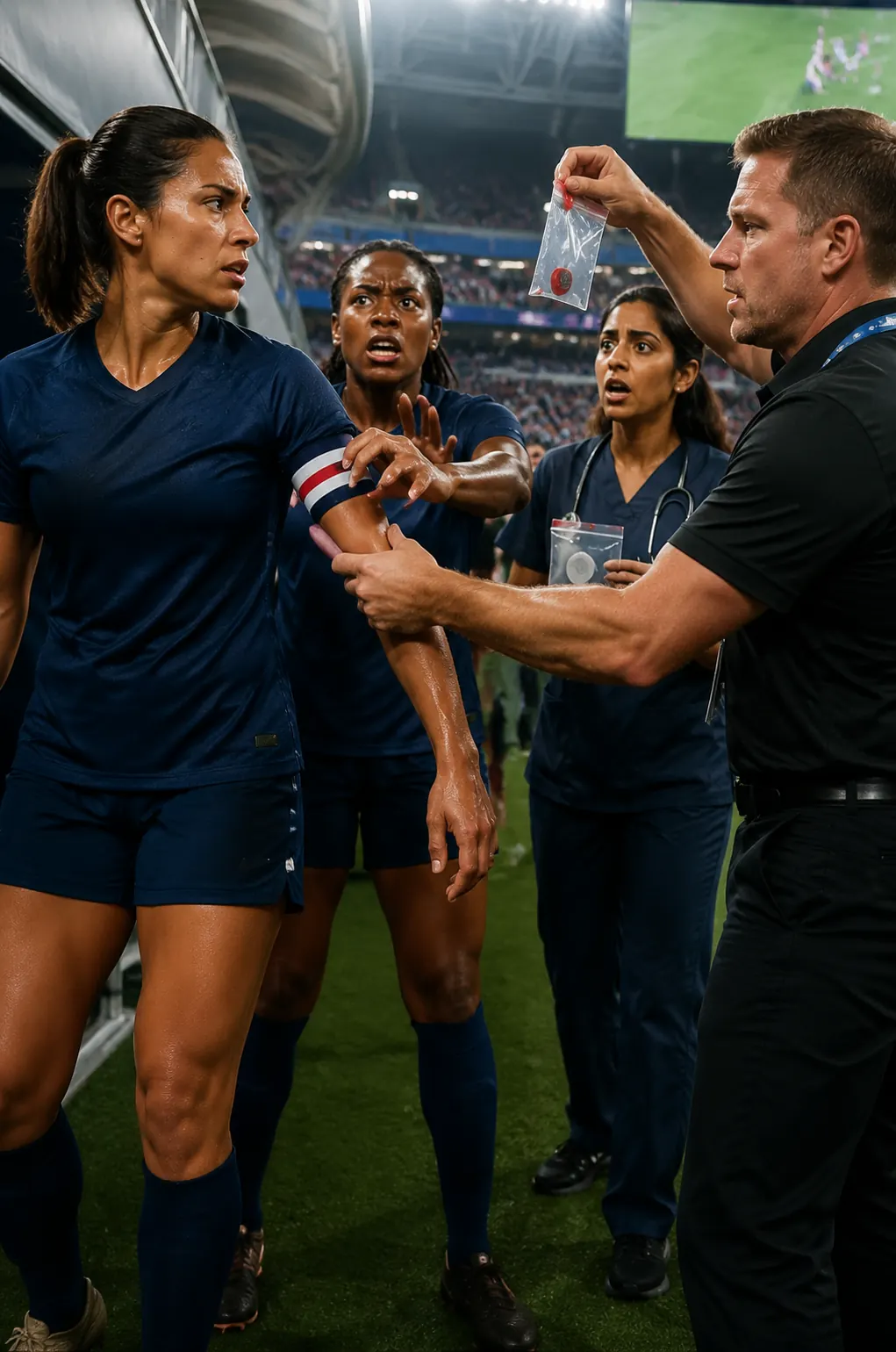
The Captain They Tested Out
Chapter 1
The Result on the Screen
Mara Velez saw the word POSITIVE before anyone said her name.
It filled the wall monitor in the Comets’ video room, black letters on a white screen, while thirty people waited for Coach Rina Solis to start the semifinal briefing. The word sat above Mara’s player number as calmly as a scoreline.
For one second, no one moved. Then the room made its small human sounds: a chair leg scraped; someone inhaled through her teeth; a phone vibrated against a table and was silenced too late.
Rina did not look at Mara. “This meeting is over.”
Mara stayed seated. Her ankle was taped under her sock, a practical decision made with the club physio that morning, and the tape suddenly felt like an accusation too. She had played twelve seasons with an intimate knowledge of what the public liked to invent about athletes’ bodies. A limp became a secret. A bad recovery became a shortcut. A woman who held her place too long became suspicious by default.
“What result?” she asked.
Dr. Colin Harrow, the club medical director, stood near the screen. His hands were folded over a folder with the Comets crest pressed into the paper. “The league notified us of an adverse finding from your collection on Monday.”
“Then why is it on our wall?”
His mouth compressed. “The league portal synchronized.”
“You were looking at the portal before the briefing.” Tessa Ward said it quietly, from two seats down. She was a defender, Mara’s closest friend on the team, and usually the first person to notice when a room had started lying.
Harrow turned toward her. “This is confidential.”
“It was.” Mara rose. She made herself put weight evenly through both feet. “Where is the notification?”
Rina finally met her eyes. There was something exhausted in them, and something worse: preparation. “Mara, the league requires a provisional restriction while it reviews the case.”
“A restriction from what?”
“Training. Matches. Team facilities, except by appointment.”
The last phrase landed harder than the first. The team facilities were not merely a building. They held the whiteboard where she had drawn set pieces for five years, the locker where Nia Brooks had left a strip of silver tape after every win, the corridor where players leaned into one another after losses. Someone had converted her life into a calendar appointment.
“We play the semifinal tomorrow,” Mara said.
“I know.”
“And you put this up in front of the team.”
Rina’s jaw tightened. “I did not put it up.”
Harrow stepped forward with the folder. “There is an appeal process. You will have counsel. You should avoid statements.”
“Did you see the sample collected?”
“Mara.”
“Did you?”
He did not answer. That was enough.
She reached into the side pocket of her training bag. The receipt was folded into quarters, soft at the creases because she had meant to file it in her kitchen drawer. She opened it on the table. Date. Time. Her signature. The collector’s initials. A seal number ending in 447.
Harrow’s eyes went to the paper and away so quickly that he might have been ashamed of the movement.
“This is my copy,” Mara said. “The number on the sealed kit was 447.”
“Keep that for your representative,” he said.
“I am keeping it.”
Outside the glass wall, someone from communications was already walking down the hall with a laptop open. The club moved fast when it needed a face for a crisis. Mara looked at her teammates. Some were staring down. Some were watching her with naked worry. Tessa was gripping the edge of her chair hard enough to whiten her knuckles.
Rina lifted the captain’s armband from the tactics table. The navy fabric had Mara’s initials stitched on the inside, a private detail nobody in the stadium ever saw.
“I have to name a captain for tomorrow,” she said.
“Do it,” Mara replied.
Tessa stood at once. “Coach,”
“Do it,” Mara said again, this time to her friend.
Rina gave the armband to Tessa. No one clapped. The silence was a mercy, but Mara hated needing it.
The communications director entered with two security staff behind him. “The league statement is being prepared. We need Mara to leave through the service entrance.”
“No,” Mara said.
He blinked. “The front has reporters.”
“Then they can see me walk.”
Harrow tried for the voice he used with injured players who wanted an earlier return date. “This is not the time for defiance.”
“No,” she said. “This is the time for a record.”
She photographed the screen, the folder, and the receipt in her hand. Then she walked past the people who had trained beside her and out toward the front doors. Camera shutters began before she reached the steps.
“Mara!” a reporter called. “Did you know the result was coming?”
She stopped because the question was wrong in a useful way. Someone had expected this result. That was what the room had told her.
“I know what I signed,” she said. “And I know the number on my receipt.”
By the time she got into her car, a message had arrived from an unknown address.
If your receipt says 447, do not let Harrow touch it. Ask who opened the corridor at 9:18 p.m.
Mara copied the message before deleting it. The hallway camera showed the same minute repeating, a cleaner pushing an empty cart through the frame three times. “You are not scheduled for this wing,” Harrow said behind her. “Neither are you.” His eyes dropped to the receipt. The fire alarm pulsed without sound. Mara slipped the paper into her sleeve and stepped toward the exit, but Harrow caught the handle first. She held his gaze until the lock clicked open on its own, then ran toward the only corridor whose camera had gone dark.
The corridor ended at the testing room, where sample bag 447 was missing from its numbered slot. Mara photographed the empty space and the access panel. Harrow followed, holding a tablet that showed the positive result with her name attached. The timestamp had shifted by nine minutes.
“That result is not mine,” Mara said.
“The league has already decided it is.”
“Then the league can explain why the seal number is missing.”
He offered a private correction if she kept the matter internal. Mara asked for the promise in writing. The intercom announced that a second test had been ordered under her athlete ID. Mara understood the trap. A new sample would become the official story while the first one vanished.
She held the receipt up to the camera. “I will test again after an independent witness seals the kit.” The camera light turned red. Mara walked out with the receipt visible, knowing the next test could protect her or complete a record they had started without her.
At the parking gate, she stopped the car and photographed the time on the dashboard. Tessa called from a borrowed number and said the league had requested every message Mara had sent during the previous week. Mara asked for the request in writing. When Tessa read it aloud, one phrase differed from the copy in Mara's folder: “voluntary cooperation” had become “failure to cooperate.” Mara recorded the call, sent the recording to June, and drove to the independent clinic named on her insurance card. She would take the second test there, with a witness, before the club could define consent for her.