

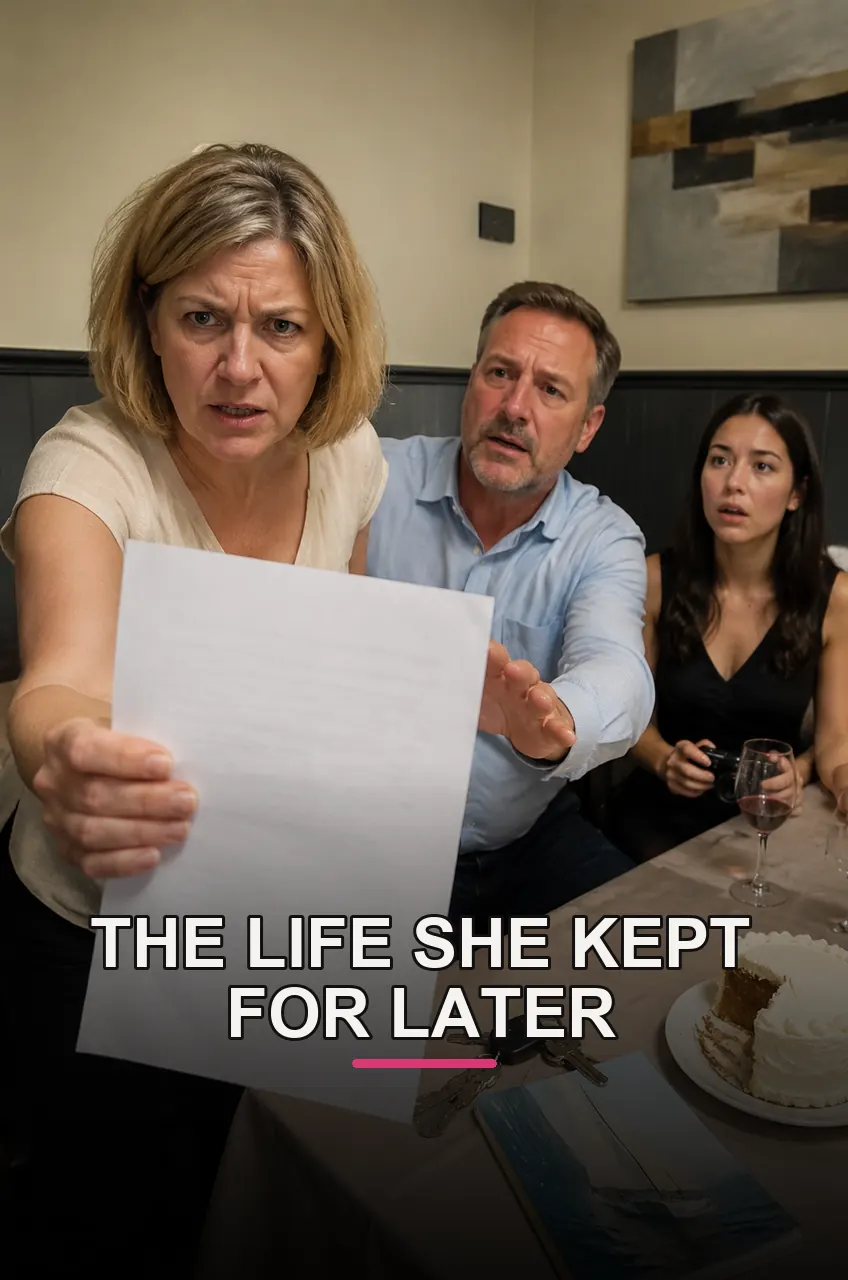
The Life She Kept for Later
Chapter 1
The House Already Sold
Celia's husband sold their house between the starter and the champagne.
He announced it as a gift.
"To the next twenty-five years," Martin said, standing at the head of the private dining table. "And to never wasting another winter waiting for summer."
Their friends raised glasses. Rowan lifted her camera because she was twenty-five and had spent half her life documenting the moments her parents preferred to remember.
Celia smiled automatically.
Martin reached behind his chair and unrolled a blue nautical chart. A red route curved from Brighton to Madeira, across to Barbados, then north through islands Celia had visited only in museum shipping records.
"We leave in September," he said. "A year. Maybe eighteen months if we find the right boat."
Everyone turned to Celia.
She heard herself ask, "What happens to the house?"
Martin's smile widened. "That's the other surprise. We accepted the offer this morning."
Applause began at the far end of the table and died before reaching her.
Rowan lowered the camera.
The present problem was easy to understand. Martin had planned an escape and included Celia as luggage. The abnormal detail lay in the word accepted. Celia had not signed anything.
She placed her napkin beside the untouched fish.
"Who accepted it?"
"I handled the agent. You hated the viewings."
"I hated strangers opening my wardrobe."
"Exactly. So I finished it."
Marianne, Celia's sister, looked down at the table. She knew something. Celia registered that without yet knowing what.
Martin lifted the chart. "You always said we would travel when things calmed down. Rowan has her own life. The museum can replace you for a year. We finally have permission."
"From whom?"
The question produced a laugh from one of his colleagues. Celia did not join it.
For twenty-five years she had translated Martin's certainty into shared intention. We decided. We thought. We felt ready. She had done it so often that even she no longer knew which decisions had once been arguments.
Martin lowered his voice. "Celia. This is what we wanted."
Rowan moved her water glass out of the camera frame. "Mum?"
There was the unresolved question beneath everything else: if Celia did not want the life Martin had arranged, what did she want instead?
She could not answer it. She could answer the contract.
Celia opened her handbag and removed a cream envelope delivered to the museum that afternoon. The agent had enclosed the final sale agreement with yellow tabs where her signature was required.
She placed it across the nautical chart.
"The buyer's solicitor sent this to my office because the electronic signature failed."
Martin looked at the blank signature line.
"We can sign tomorrow."
"You told them I had agreed."
"You did agree. In principle."
"Three years ago, before my mother died, before Rowan left home, before I was offered the Linton collection."
"You turned down the Linton collection."
"Because you had just started the consultancy and someone needed a salary that month."
The table became very still. Celia had never said that sentence in public. She had barely said it privately.
Martin folded the chart along an existing crease. "This is not the place."
It was the phrase that ended many Ward family conversations. Not here. Not now. Not in front of Rowan. Not before the mortgage renewal. Not during Christmas. Their marriage had become a museum of postponed arguments, each carefully labeled and never displayed.
Celia picked up the contract.
"Where is the deposit?"
"Held by the agent."
"Refundable?"
Martin did not answer quickly enough.
Marianne set down her champagne. "Celia, I told him you might need time."
"You knew?"
"Only about the trip."
"How long?"
"Since February."
Four months. Her sister had known four months and had mistaken silence for kindness.
Rowan stood. "I need some air."
Celia almost followed. The impulse was ancient: protect Rowan first, then return when everyone had adjusted their version of events. Rowan put one hand up.
"Don't make me the reason you leave the table," she said.
She walked out alone.
Martin watched the door close. "She is upset because you are upset."
"She is upset because we trained her to manage us."
"I was trying to give you something."
Celia looked at the route, the sale agreement, the anniversary cake waiting beneath a silver cover. The absence of cruelty made the moment harder. Martin loved a version of her whose consent could be inferred from good intentions.
The waiter entered with the cake and stopped.
Twenty-five small candles burned around the edge. Their friends looked everywhere except at Celia.
She stood.
"I am not going on the boat."
Martin's face changed before he could control it.
"You're embarrassed. We can discuss this at home."
"I am not going home with you tonight."
She gave the unsigned contract to Marianne.
"Keep that."
"Where will you go?" Martin asked.
Celia had no plan beyond the restaurant door. Then Marianne reached into her bag and placed an old brass key beside the nautical chart.
"Mum left you something," she said. "I was going to wait until tomorrow."
A paper tag hung from the key in their mother's handwriting.
MARLOWE PICTURE HOUSE - SIDE DOOR.
Celia picked it up.
Her mother had been dead for nine months. The Marlowe had been locked for seventeen years.
The key was warm from Marianne's hand.
Celia set the key beside her plate. Martin kept talking about tax advantages, but the people around the table had stopped eating. Marianne's solicitor watched Celia with the patient attention of someone waiting for a signature.
"You sold the Marlowe without telling me," Celia said.
"I secured our future."
"You secured a buyer."
Rowan unfolded the sale notice. The closing date was tomorrow, not next month. Martin had arranged the dinner to make the sale look like a family decision after it had already become a legal fact.
Marianne's hand shook once. "The house was never yours to sell."
"The deed says otherwise."
Celia picked up the key. Its teeth matched the old cinema's side door, the one her mother had kept locked for seventeen years.
She stood. Martin's chair scraped back.
"Where are you going?"
"To see what you sold."
The solicitor blocked the entrance. Celia placed the key in her pocket and called Rowan. "Bring the original deed. If he filed the transfer, I want the timestamp."
Martin's phone lit with a message from the buyer. Celia saw one line before he turned it facedown: ACCESS CODE CHANGED. Rowan arrived with the original deed. The transfer had been filed at 3:12 that morning by a company incorporated the day before. It included the cinema, projection booth, and the apartment where Celia's mother kept family papers.
The preservation application called the cinema an active community archive, contradicting Martin's claim that it was vacant. A survey crew measured the curb while a gray-coated man photographed the house.
"The key is inside," Celia said.
The deadbolt had been changed. Movement sounded behind the kitchen window. The solicitor warned that entering could damage Celia's claim, so she called the police and documented the access change.
Martin's phone lit again: THE ROOM HAS BEEN CLEARED. Celia folded the deed into her coat and turned toward the cinema. Whatever remained of the archive had to be found before the buyer erased it.