

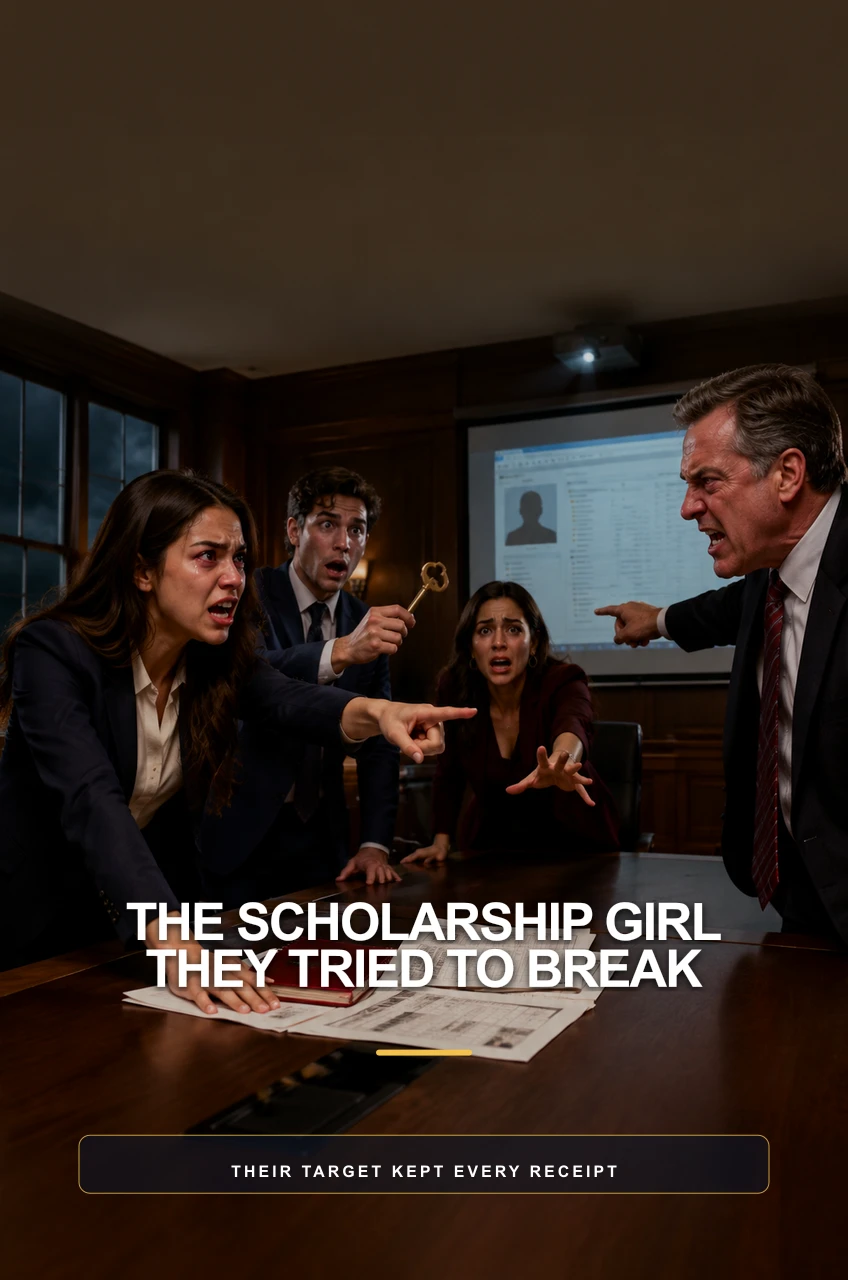
The Scholarship Girl They Tried to Break
Chapter 1
The Empty Seat
Mara arrives at a scholarship dinner to find her name removed and her private financial file projected as a joke.
Bellweather University kept moving beyond the glass as if private disasters were only changes in weather. Mara Reyes held a library master key and listened for the lie beneath the explanation.
Mara Reyes had learned that dangerous people preferred speed. Speed shortened questions. It made panic look like consent and silence look like agreement. She slowed the moment down instead. She checked the door, the available exits, the names being used, and the names being avoided. Then she asked the question no one in the room wanted recorded.
She photographs the projector log while the society waits for her to cry. The answer changed the shape of the problem. What had looked like one person’s cruelty belonged to a system: money routed through respectable accounts, favors disguised as protection, witnesses reduced to liabilities. Adrian Bell could see the instant she understood. He did not reach for her. He moved the evidence within her sight and waited.
Mara Reyes did not confuse proximity with safety. Adrian Bell could make a useful choice and still remain part of the machine closing around her.
“Say exactly what you are offering,” Mara Reyes said.
Adrian Bell did. He left out the promise that everything would be fine. Neither of them respected promises that required the world to become kinder. He offered an action, a deadline, and something he would lose if he failed.
Mara Reyes wrote the facts in order and separated what frightened her from what could be proved. Fear was information, not an instruction.
They tested the new fact against the record. One timestamp failed. A signature appeared in the wrong hand. A person who claimed not to know the victim had used a private phrase from the sealed file. By the time the pattern settled into place, the safest story was no longer believable.
Mara Reyes felt the pull between survival and exposure. Leaving might protect one body for one night. Staying could put names to the people who expected fear to keep doing their work. She chose the next move because it was hers to choose, not because Adrian Bell made danger look attractive.
The file was opened with Adrian Bell’s faculty access card.
Mara copied the projector log before the dean could shut down the screen. The file showed three edits made at 6:12 that morning. Her name had been removed from the scholarship dinner, her financial records attached, and a note added: annual target.
“Who authorized this?” Mara asked.
The dean called security. Adrian Bell stepped between them. “Let her leave with the log.”
“You designed the access system,” Mara said. “You could have stopped it.”
“I could have stopped tonight. I did not know about the target list.”
She took his key card when he offered it. The card opened the Bellweather Circle office beneath the library. Adrian followed at a distance while Mara photographed every folder. Each year held one student whose housing, grades, and internships had been quietly damaged. The pattern was too regular to be gossip.
Mara found June Patel’s name and called her. June answered from a bus station and said the university had threatened her family. She would speak only if Mara recovered the original disciplinary audio.
Adrian located the audio archive. The file had been deleted, but the backup server retained a fragment. A voice accused June of cheating, then another voice ordered the recording sealed. Mara recognized the second voice as Celeste Bell, Adrian’s cousin.
“Your family built this,” Mara said.
“My family built the lock. I am giving you the key.”
The office lights blinked. Someone was entering the library. Mara sent the recovered fragment to her personal account, then handed Adrian the notebook. “If I disappear, publish it.”
“If you disappear, I will find you.”
“That is not a plan.”
“It is the first step.”
They left through the stacks as security searched the office. At the exit, Mara saw her scholarship portal change from active to revoked. The university had made its decision before the dinner began.
She turned to Adrian. “Then I will make mine.”
She pressed the upload button and released the first file to every student on campus.
The response arrived before she reached the library steps. Messages multiplied across her phone, some demanding proof, others offering names and dates. One came from a number she did not recognize. It contained a photograph of a locked basement and a sentence: The archive is not the oldest room on campus.
Adrian read the message over her shoulder. “That is where the board keeps emergency records.”
“Then we go there.”
“Security will be waiting.”
Mara closed the scholarship portal and put his key card in her pocket. “They have been waiting for years. We are late.”
They crossed the courtyard while the dinner guests spilled into the hall, each person carrying a different version of the scandal. Mara entered the library and pulled the false catalog drawer marked 1978. Behind it, a stairwell opened into darkness.
The stairwell camera rotated toward her. Adrian reached for the switch, but Mara held up her hand.
“Let it record.”
She stepped down first, carrying the evidence that had cost her a scholarship and might buy every other student a choice.
At the bottom, Mara found a cabinet of admission files and an access log showing the dean had searched for her mother. “This began before I arrived,” she said. Adrian looked toward the corridor. “Then it can end with us.” They copied the index and returned to the library, where students were forwarding the leak. The campus had become a witness, and no one could lock every door at once.
Mara made a second copy before anyone could call the first release a mistake. She labeled it with the date, the room, and the names of every student who had watched the screen. Adrian asked whether she wanted him to carry the drive. She kept it in her own coat.
“You keep offering to stand in front of me,” she said. “Stand beside me instead.”
He nodded and opened the catalog terminal. Together they searched old records for withdrawals that followed the same pattern: a conduct note, a housing complaint, then a donor-funded replacement. Seven names appeared in one semester. Three had no forwarding address. One belonged to a student Mara had tutored in the library, a sophomore who vanished after reporting a stolen exam.
The discovery changed the task from defending one scholarship to proving a repeatable method. Mara wrote a checklist for every witness: preserve the original, record who had access, and never surrender a copy without a receipt. She sent it to the students who had answered her leak.
When the library doors locked for the night, the crowd outside did not disperse. They waited with phones raised and questions ready. Mara looked at the empty seat where her name had been printed and understood that the seat was no longer an invitation. It was evidence. She walked toward the waiting students and began taking statements. Each statement carried a name, a date, and a promise to preserve the truth.