
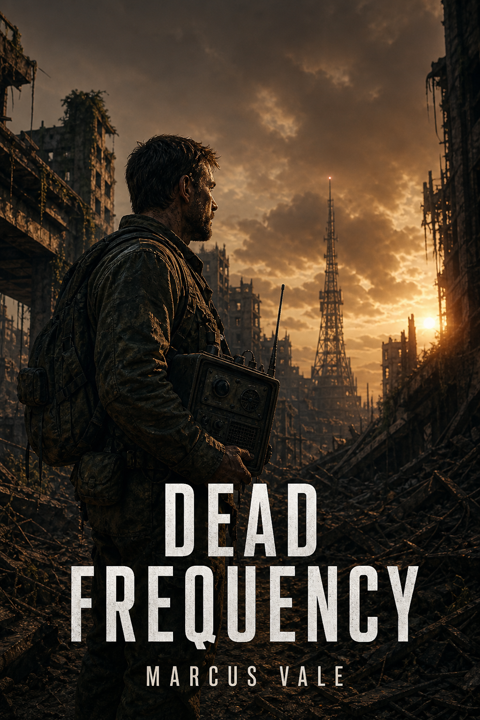
Dead Frequency
Marcus Vale
Chapter 1
Chapter 1: Static and Signal
Chapter 1: Static and Signal
The receiver was a piece of junk I'd built from three different pieces of junk. A chassis stripped from a pre-Quiet emergency band radio, a capacitor array I'd scavenged from a hospital basement in the east sector, and a coil wound by hand from copper wire I'd pulled out of a transformer that used to step down power for a textile mill. The mill had been gone for twenty-eight years. The transformer, longer. I'd found it buried under six feet of rubble and flood silt along the river bend, and I'd thought it was the best thing I'd found in a decade.
I was right. It was.
The shack sat on the third floor of what used to be a parking garage on Prentiss Avenue. Two outer walls were still standing. The other two I'd rebuilt with concrete block and timber, which meant the whole structure was technically illegal by the standards of the Haven Falls Building Council, who had neither the authority nor the manpower to do anything about it. I'd reinforced the floor joists. I knew what I was doing. I'd been doing it for eleven years, since I left the militia and stopped taking orders from men who thought power came from the barrel of a gun rather than the knowledge of how to keep people alive.
It was a Thursday in late October, or what passed for late October. The calendar I kept was pencil marks on a piece of drywall, and I'd lost track twice over the years due to illness and once due to a situation with a scavenger crew from the north sector that I don't talk about. But the cold said October, the angle of the light through the gap where the eastern wall met the ceiling said late afternoon, and the damp in the air said rain before morning.
I was calibrating the coil tension. A process that required patience and a flat-blade screwdriver and a tolerance for tedium that I'd developed over the course of a life that had given me very little else to do. The shortwave range was full of static on most days. Atmospheric noise, residual interference from whatever the cascade had done to the ionosphere thirty years back. Some people said the ionosphere had healed itself within a decade. Some people said the cascade had punched a permanent hole in it that EM could slip through sideways. I wasn't a physicist. I just listened.
I found the signal at 3847 kilohertz.
Pre-Quiet, that frequency had belonged to a military command network. I knew because I'd served in the 12th Signals Battalion before The Quiet, and we'd used adjacent channels for tactical relay. After the cascade took everything down, those frequencies sat empty. No one was transmitting on military bands. No one had the equipment. No one had the power. The council's public communication system ran on mechanical telegraph, same as it had for fifteen years, and the scavenger gangs used runners and hand signals and mirrors. The last working radio I'd heard of besides my own was a crystal set that a man named Fowler ran out of a basement in the old university district, and Fowler only received, never transmitted, and his range was less than thirty kilometers on a good day.
The signal on 3847 was not Fowler's crystal set.
It was clean. Cleaner than anything I'd heard in thirty years. No warble, no drift. A stable carrier wave that someone was keying with practiced rhythm. Slow enough to be deliberate. Fast enough to tell me the person on the other end knew what they were doing.
I stopped turning the screwdriver.
I listened.
Morse code is a language you forget the way you forget a language you learned as a child in a country you left. The shapes of it disappear from the front of your mind. But they don't leave. They go somewhere deeper, somewhere that doesn't require you to think, and when you hear it again you understand before you've consciously decoded a single letter. It's muscle memory of the ear.
The first group came through and I understood it before I'd even reached for the pencil.
I reached for the pencil.
I wrote it down anyway. Because I needed to be sure.
Seven words.
I stared at the paper for a long time after the signal ended. My hand was steady. My hand was always steady. It was one of the things the militia had kept from me when I left — the steadiness. The capacity to look at something terrible without the muscles in my face or hands betraying me.
My chest was a different matter, but no one could see that.
I read the words again.
THE QUIET WAS ENGINEERED. THEY'RE STILL WATCHING.
The signal lasted four minutes and twelve seconds. I timed it on the clockwork chronometer I kept bolted to the bench, one of the few functional timekeeping devices in the sector that didn't belong to the council. During those four minutes and twelve seconds, the message repeated three times. Identical spacing. Identical rhythm. No variation in tone or timing that would suggest a human operator growing tired or distracted. It could have been automated. A loop, triggered and left to run.
Or it could have been a human being who was very, very precise.
When it stopped, I sat in the silence for two minutes before I moved. I listened to the frequency for harmonic echoes, secondary carriers, anything that might tell me something about the transmitter's power output or direction. The atmospheric conditions gave me nothing useful. The signal had come from somewhere — that much was certain — but the ionospheric bounce made direction-finding without additional equipment essentially impossible.
I had a notebook under the bench. Pre-Quiet military issue, waterproof cover, the kind we'd used for field logs. I'd found it in a cache six years ago and saved it for something worth writing down. I'd been waiting six years to find something worth writing down. I opened it now and wrote the date as best I knew it, the time from the chronometer, the frequency, the signal duration, and the message. Then I wrote: Carrier characteristics: clean, stable, no modulation drift. Power output: estimated sufficient for regional or inter-regional propagation. Transmission mode: CW, Morse, manually keyed or precise automated loop. No identification code. No callsign. Intentionally unattributed.
I underlined that last part.
Continue reading
Next chapter →